
I was at a gym class recently when one of the women there asked me to remind her what I’d said about creatine. Another woman turned to the exercise physiologist in the room and asked what he thought.
He said he doesn’t really use it, because he doesn’t drink enough water. You need at least an extra litre a day, he said, to protect your kidneys.
I said that as long as you’re hydrated in a normal way, you’d be fine. And in my head I was fairly sure the extra litre wasn’t right. But I didn’t push back any harder than that, because I hadn’t checked, and I’m not going to challenge someone in front of a room on something I haven’t verified.
So I came home and read the research. This article is what I found.
It’s also, more broadly, about why nutrition advice feels so confusing right now. Because he’s qualified. He wasn’t showing off. He genuinely believed it, and it sounds sensible, which is precisely why advice like that travels so well.
What is creatine, and why does it matter in midlife?
Creatine is a compound your body makes from amino acids, mostly in your liver and kidneys. You also get small amounts from food, mainly red meat and fish. It’s stored primarily in your muscles, with smaller amounts in your brain, and its job is to help regenerate energy at a cellular level.
It got branded as a bodybuilding supplement decades ago, and midlife women were quietly written out of the conversation as a result.
Here’s why that’s a shame. Women carry roughly 70 to 80% lower stores of creatine than men. Research on creatine across the female lifespan suggests it may be particularly relevant during and after menopause, a period when muscle mass and bone density both decline more rapidly.
That’s the honest reason creatine is worth your attention in your forties and fifties. Not because it’s trendy. Because the thing it supports, muscle, is the thing your body is working hardest to hold onto.
Does creatine damage your kidneys?
This is the question that stops most women before they start, and the evidence is reassuring.
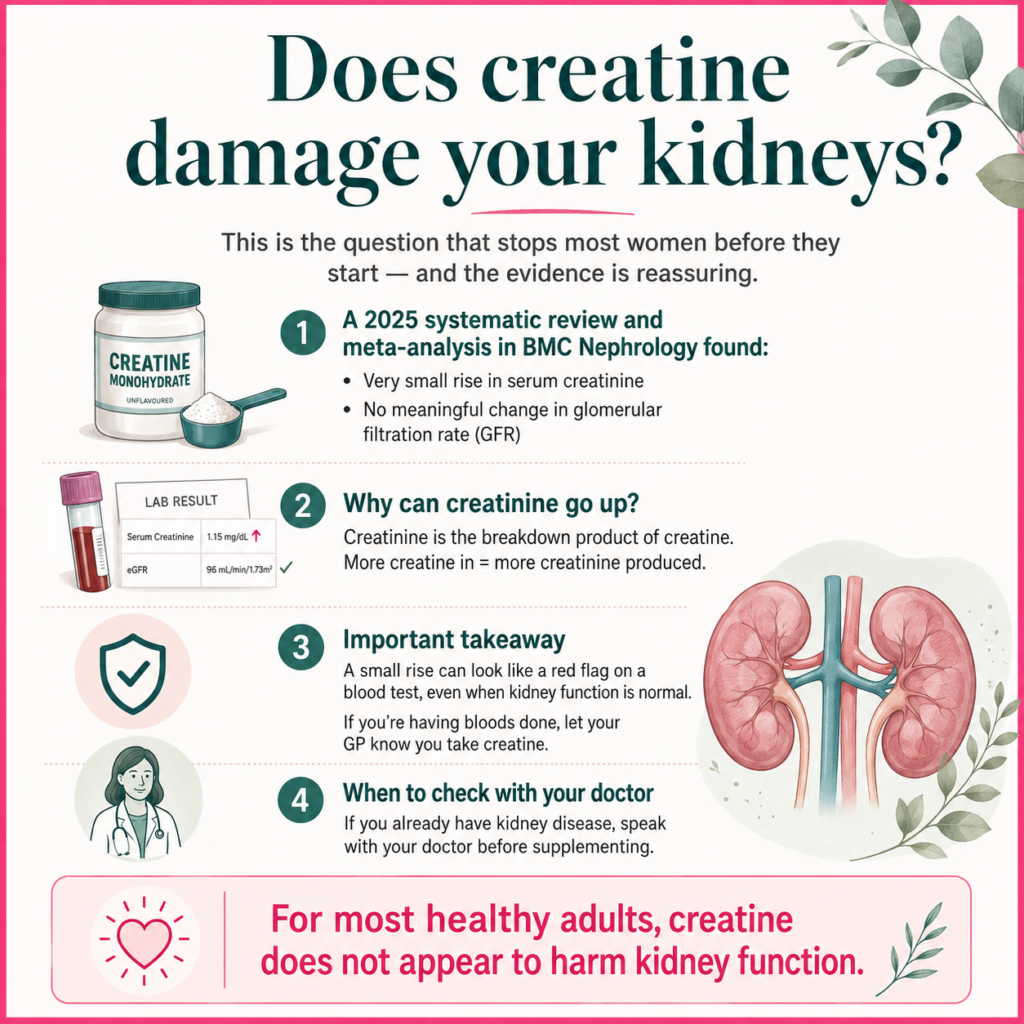
A 2025 systematic review and meta-analysis published in BMC Nephrology examined creatine supplementation and kidney function. It found a very small rise in serum creatinine, and no meaningful change in glomerular filtration rate, which is the actual measure of how well your kidneys are filtering.
So why does creatinine go up? Because creatinine is the breakdown product of creatine. Take more creatine in, produce more creatinine. It’s ordinary metabolism, in the same way that eating more protein increases nitrogen waste. More waste passing through the system doesn’t mean the system is struggling.
The genuinely useful takeaway: that small rise can look like a red flag on a blood test if nobody knows you take creatine. There’s medical literature on doctors misreading exactly this. So if you’re having bloods done, mention it to your GP. It takes five seconds and it can save you a scare.
If you have existing kidney disease, that’s a different conversation and one to have with your doctor. But that’s true of many things, and it isn’t a reason for everyone else to be put off.
Does creatine cause kidney stones?
I’ve seen this claimed with real confidence online, including by an influencer posting from a hospital bed.
Kidney stones form from calcium oxalate, uric acid or calcium phosphate. Creatine isn’t a precursor to any of them. There’s no established mechanism by which creatine would cause a stone to form, and no controlled evidence showing that it does.
It’s also worth saying that bodybuilding at a competitive level usually involves several practices at once. Very high protein intake, deliberate dehydration, anti-inflammatories, and sometimes anabolic steroids. Reviews of kidney function in this population note documented risks from those practices, while finding little evidence that moderate creatine supplementation poses a risk to people with normal kidney function.
Picking creatine out of that pile and blaming it isn’t science. It’s a guess with a large audience.
Do you need to drink extra water with creatine?
This is the claim I went home to check, and it doesn’t hold up.
The International Society of Sports Nutrition position stand states that claims about creatine causing dehydration and muscle cramping are not supported by the evidence. If anything, the research points the other way: creatine may improve hydration status and reduce cramping. A 2025 safety review reached the same conclusion, finding no significant effects on hydration or thermoregulation in controlled studies.
I could not find a study anywhere establishing a specific extra volume of water you need to drink.
So where does the extra litre come from? Probably from a reasonable-sounding misunderstanding. People know creatine draws water into muscle cells, so they assume it must be pulling water out of everywhere else and that you need to top it back up. That isn’t how fluid balance works. Your body isn’t a set of buckets.
Normal, adequate hydration is fine.
Why does creatine make some women bloated?
Usually because it hasn’t dissolved.
Creatine monohydrate has limited solubility in cold water. Tip five or ten grams into a small glass and a good portion of it sits at the bottom as grit. That undissolved powder is the most common cause of the bloating and gut discomfort people then blame on creatine itself.
What to do about it:
- 🌿 Use a decent volume of liquid, not a small glass
- 🌿 Warm water dissolves it far better than cold
- 🌿 Split your dose rather than taking it all at once
- 🌿 Stir it properly, and drink it before it settles
Gut upset is dose-dependent, so it shows up more with large single doses. That’s another argument for splitting.
Separately, some women notice a small increase on the scales when they start. That’s water drawn into muscle cells, not fat. If the number on the scale is the thing that would stop you, that’s worth sitting with for a moment, because it’s a diet-culture reflex rather than a health signal.

How much creatine should a woman take?
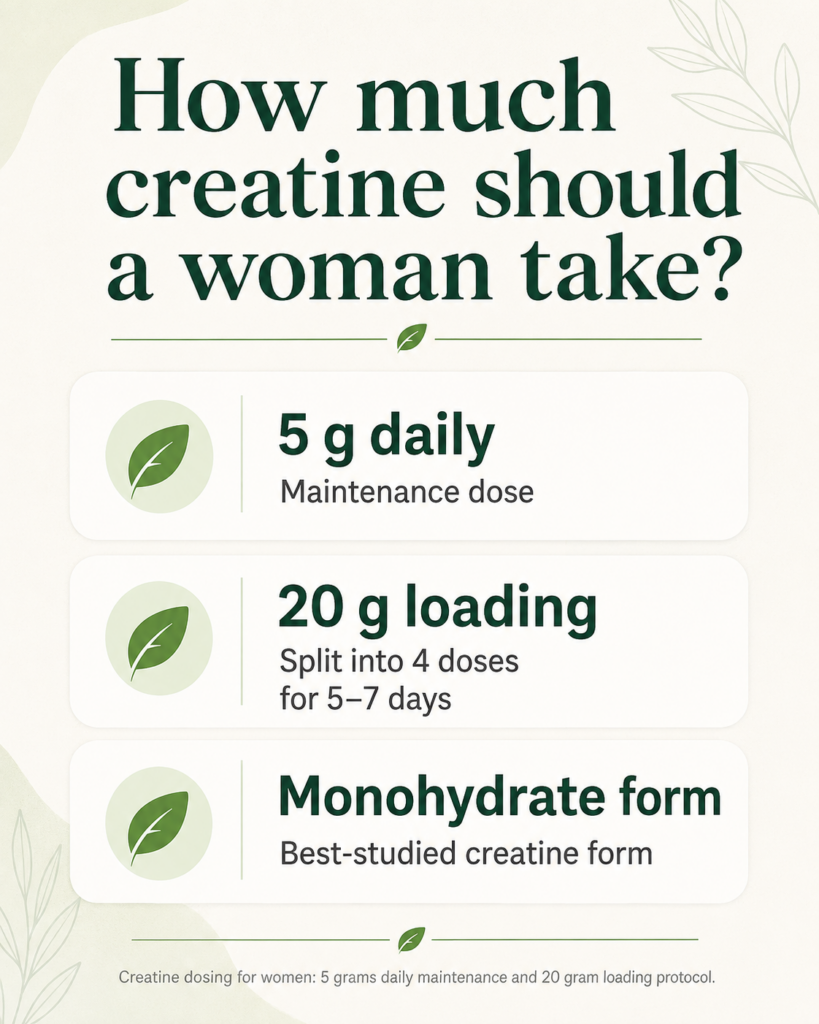
5 grams a day is the well-established dose. It saturates your muscle stores, and for muscle strength and function it’s all you need.
The important caveat: the muscle and bone research is built on creatine combined with resistance training. Research in postmenopausal women suggests creatine may support muscle size and function, with favourable effects on bone when it’s paired with training. Paired with. Creatine is not a substitute for lifting something heavy, and I’d rather tell you that than sell you a shortcut.
20 grams a day is a loading protocol, not an ongoing dose. In the research it’s split into four 5 gram doses across the day for five to seven days, then dropped back to three to five grams. It’s a way of saturating faster. Loading is optional. Take five grams daily and you’ll get there in a few weeks anyway.
Form: creatine monohydrate. It’s the form used in almost all of the research. The fancier versions cost more and the evidence that they’re superior is thin.
Timing: less important than consistency. Take it at a time you’ll actually remember.
Does creatine help with brain fog in perimenopause?
This is where I want to be straight with you, because it’s where most of the internet isn’t.
The interest in creatine and cognition is real. Your brain uses the same energy system your muscles do. But creatine doesn’t cross the blood-brain barrier easily, which is why some of the literature suggests higher intakes, around 10 grams a day, may be needed to shift brain creatine levels at all. Some researchers put the threshold higher again.
That dose has been tested for safety: a randomised controlled trial gave 10 grams daily for three months and found no kidney dysfunction.
But safety and benefit are two different questions. A 2024 systematic review and meta-analysis of sixteen randomised trials found moderate certainty evidence for memory, and low certainty for processing speed, overall cognition, executive function and attention.
And there are no trials in perimenopausal or menopausal brain fog specifically. None.
The mechanism is plausible. Women have lower creatine stores, oestrogen influences how creatine behaves in the body, and brain fog is one of the most common complaints I hear. Plausible is a good reason to be interested. It isn’t a reason to promise anyone anything.
If you see creatine sold as a fix for brain fog, that claim is ahead of the science.
Who should check with their GP first?
🌿 Anyone with existing kidney disease
🌿 Anyone pregnant or trying to conceive
🌿 Anyone on medication who isn’t sure about interactions
🌿 Anyone with a health condition they’re actively managing
This is general information, not a recommendation for your individual situation.
The bigger point
That exercise physiologist wasn’t reckless. He was passing on something that sounded sensible and that he believed. That’s what makes this hard. It isn’t that there are villains deliberately misleading you. It’s that confident, well-meant, slightly wrong advice sounds exactly like good advice when you’re standing in a gym trying to decide.
I didn’t challenge him properly on the day, because I wasn’t certain enough. I went home and did the reading first. I’d rather do that than be the person who’s loudly confident and wrong.
So if you feel confused about nutrition right now, that isn’t you being slow or not trying hard enough. The information environment is genuinely a mess, and some of the messiest parts come from qualified people, not just influencers.
You don’t need to become an expert in all of it. You need someone who will do the reading, and who will tell you when the honest answer is that we don’t know yet.
Science, not shame. 💚
Working out what your body actually needs in midlife?

I’m Sally Bloomfield, a qualified nutritionist based on the Sunshine Coast. I work with women in perimenopause and menopause who are tired of conflicting advice and want to understand their own body again.
References
- Kreider RB, et al. International Society of Sports Nutrition position stand: safety and efficacy of creatine supplementation. Journal of the International Society of Sports Nutrition. 2017;14:18.
- Antonio J, et al. Common questions and misconceptions about creatine supplementation. Journal of the International Society of Sports Nutrition. 2021.
- Systematic review and meta-analysis of creatine supplementation and kidney function. BMC Nephrology. 2025.
- Smith-Ryan AE, et al. Creatine supplementation in women’s health: a lifespan perspective. Nutrients. 2021;13(3):877.
- Xu C, et al. Effects of creatine supplementation on cognitive function in adults: systematic review and meta-analysis. Frontiers in Nutrition. 2024.
- Candow DG, et al. Does one dose of creatine supplementation fit all? Advanced Exercise and Health Science. 2024.
This information is general in nature and does not replace individual medical advice. For persistent or concerning symptoms, please consult your GP or a qualified healthcare provider.