
If you feel like your body has quietly changed the rules without telling you, you’re not imagining it.
You’re eating the way you always have. Maybe you’re even eating “better” than you used to. And yet you’re bloated by mid-afternoon, your energy dips out of nowhere, your digestion feels less predictable, and the weight is sitting differently. The strategies that worked in your thirties just… don’t anymore.
This is one of the most common things women say to me in perimenopause and menopause. And it’s not a willpower problem. It’s a biology problem — and a big part of it comes back to your gut.
Here’s what’s actually happening, and the practical, food-first changes that can help. No detoxes. No restriction. No shame.
What’s actually changing
During perimenopause, oestrogen doesn’t switch off neatly — it fluctuates, often wildly, before gradually declining. Oestrogen is far more than a reproductive hormone. It influences how you store fat, how sensitive you are to insulin, how much muscle you hold, your mood, your sleep, and — importantly — your gut.
As oestrogen declines, several things tend to shift together: more fat is stored around the middle, the body can become a little less responsive to insulin (so blood sugar is harder to keep steady), muscle becomes easier to lose, and digestion can become slower or more sensitive. None of these mean anything has gone “wrong.” They’re a normal part of the transition. But they do mean your nutrition may need to change too.
The gut–oestrogen connection (in plain English)
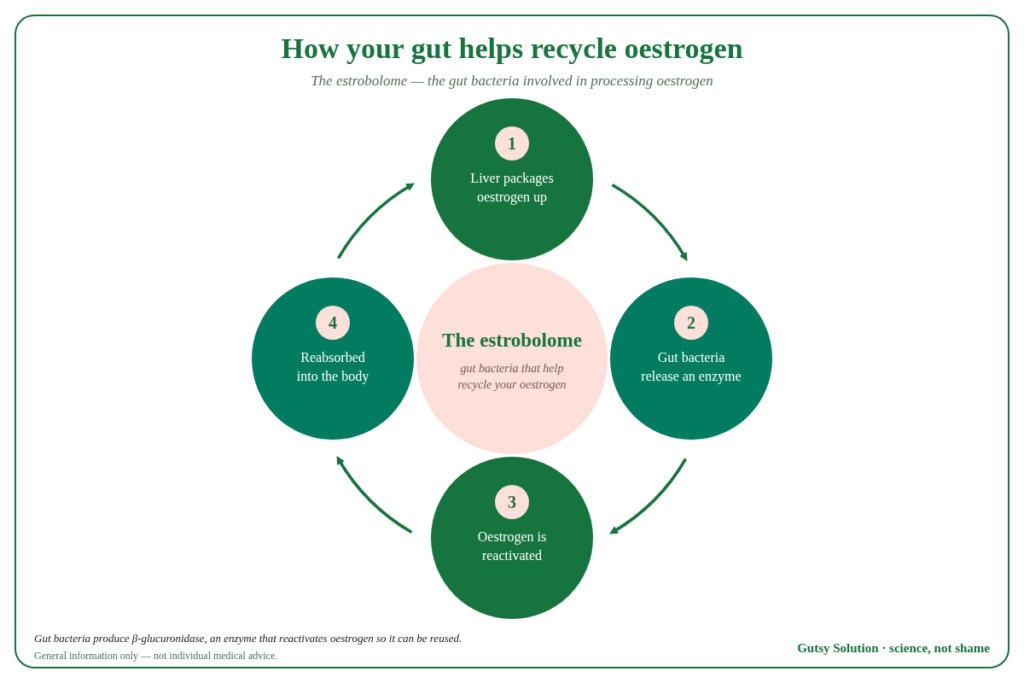
Here’s the part that doesn’t get talked about enough.
Your gut is home to trillions of bacteria, and a specific community of them is involved in how your body handles oestrogen. Researchers call this collection of microbes and their genes the estrobolome. In simple terms, these bacteria help regulate how oestrogen is processed and recycled in the body, rather than simply being cleared out.
When your gut microbiome is diverse and well-fed, that system tends to run smoothly. The interesting — and still emerging — finding is that gut diversity is often lower after menopause than before it. Research published in 2025 suggests this reduced diversity may, in turn, influence how oestrogen is metabolised. The relationship appears to run both ways: hormonal change can affect the gut, and the gut can affect how hormones are handled.
It’s important to be honest about where the science sits: this is an active and promising area of research, not a settled one, and it’s an association rather than a switch you can simply flip. But it gives us a very practical takeaway. Looking after your gut is one of the most useful, evidence-aligned things you can do for your body in midlife — because a healthier gut supports digestion, steadier energy, and the systems oestrogen is connected to.
Why bloating and digestion change
Two everyday changes explain a lot of the bloating and digestive discomfort women notice in perimenopause.
First, digestion tends to slow with age and with falling oestrogen, which can mean food moves through more slowly — leaving more room for gas, fullness, and that “blown up by 3pm” feeling.
Second, most of us simply aren’t feeding our gut bacteria enough of what they thrive on: fibre and plant variety. When the beneficial bacteria are underfed, the whole system becomes less comfortable and less resilient.
The good news is that both of these respond well to food — which is where the practical part begins.
What actually helps
These are the changes that tend to make the biggest difference. You don’t need to do all of them at once. Pick one, let it become a habit, then add the next.
1. Close the fibre gap (gently)
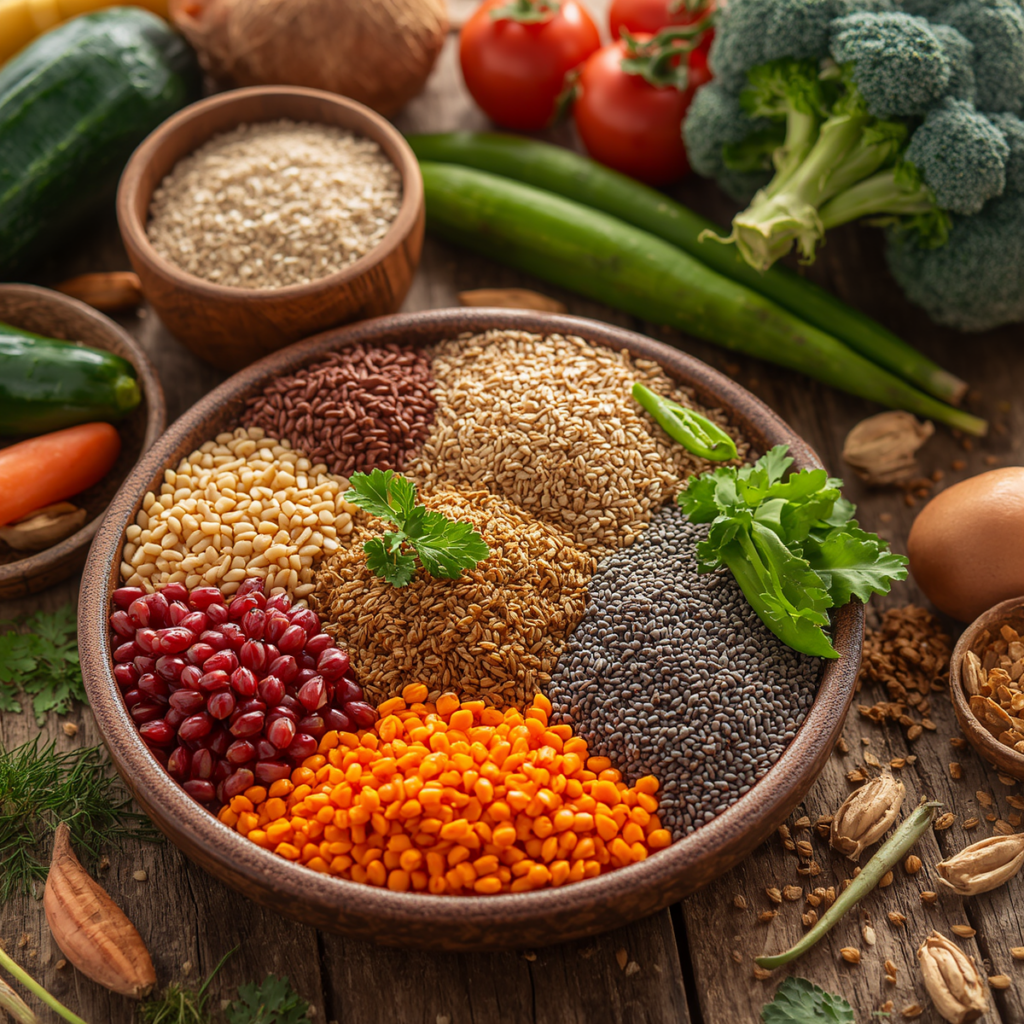
Fibre is the single most important food for your gut bacteria — it’s what they ferment to produce compounds that support a healthy gut lining, steadier blood sugar, and lower inflammation.
In Australia, the suggested target for women is around 25 grams of fibre a day, rising to about 28 grams for added protection against chronic disease. Yet most Australian women fall short, averaging closer to 21 grams. That gap is small on paper but meaningful in practice.
Easy ways to close it:
- Leave the skin on fruit and vegetables where you can
- Swap to wholegrain bread, brown rice, oats, and quinoa
- Add half a tin of lentils or chickpeas to soups, sauces, salads, and casseroles
- Sprinkle chia, ground flaxseed, or hemp seeds onto breakfast
- Add one extra vegetable to your evening meal
One important note: increase fibre slowly and drink more water as you do. Going from low to high fibre overnight is the fastest way to more bloating, not less. Add one new high-fibre food every few days.
2. Prioritise protein at every meal
As oestrogen falls, it becomes easier to lose muscle — and muscle is what keeps your metabolism, strength, and blood sugar working in your favour. Protein is how you protect it.
Current evidence suggests women in midlife do better with more protein than the old minimum guidelines assumed — generally in the range of 1.0 to 1.2 grams per kilogram of body weight per day, and a little higher (up to around 1.6 g/kg) if you’re actively strength training or losing weight. For many women that looks like roughly 25–30 grams of protein per meal, or a palm-sized serve of a protein food at each sitting.
Protein has a second benefit here: eating it alongside carbohydrates helps steady the blood sugar response, which can mean fewer energy crashes and less afternoon snacking.
3. Eat the rainbow — and add fermented foods
Gut diversity loves food diversity. One of the most well-supported habits for a healthy microbiome is simply eating a wide variety of plants across the week — different vegetables, fruits, wholegrains, legumes, nuts, and seeds. Aim for variety rather than perfection.
Fermented foods can help too. Yoghurt, kefir, sauerkraut, kimchi, and similar foods introduce beneficial microbes and may support a more balanced gut. Start with small amounts and see how you feel.
Polyphenol-rich foods — berries, extra virgin olive oil, dark chocolate, green tea, herbs, and colourful vegetables — also feed beneficial bacteria and bring an anti-inflammatory benefit.
4. Steady your blood sugar (without obsessing)
You don’t need to track glucose or fear carbohydrates. A few simple habits do most of the work: build meals around protein and fibre, choose wholegrain over refined where you can, and avoid drinking your carbohydrates (juice and sweet drinks hit hardest). Steadier blood sugar tends to mean steadier energy and mood.
What doesn’t help: detoxes, cleanses, and another diet
Here’s the honest part. The “menopause detox,” the cleanse, the dramatic elimination diet — these don’t fix the gut, and restriction often makes digestion and your relationship with food worse. There’s no quick fix to flush here. Your gut responds to consistent, varied, real food over time. That’s less exciting than a 3-day cleanse, but it’s what actually works.
The most important point: you’re an n=1
Everything above is a strong, evidence-aligned starting point. But your gut, your symptoms, your history, and your response to food are entirely your own. Two women the same age can need quite different things.
That’s the whole idea behind a personalised approach — not guessing from generic advice, but working out what your body is asking for now. Because you don’t need another restrictive diet. You need to understand what’s changed, and what works for you.
If your symptoms are persistent, severe, or worrying you, please see your GP or qualified healthcare provider — some symptoms need proper medical assessment, and food is one piece of a bigger picture.
This information is general in nature and does not replace individual medical or nutrition advice. For persistent or concerning symptoms, consult your GP or a qualified healthcare provider.
References
- Wang H, et al. Gut microbiota has the potential to improve health of menopausal women by regulating oestrogen. Frontiers in Endocrinology. 2025;16:1562332.
- Liu Y, Guo X. Dietary interventions and nutritional strategies for menopausal health: a mini review. Frontiers in Nutrition. 2025;12:1702105.
- Peters BA, et al. Menopause is associated with an altered gut microbiome and estrobolome, with implications for adverse cardiometabolic risk. mSystems. 2022;7(3):e00273-22.
- Spotlight on the gut microbiome in menopause: current insights. International Journal of Women’s Health. 2022.
- National Health and Medical Research Council (NHMRC). Nutrient Reference Values for Australia and New Zealand — Dietary Fibre. eatforhealth.gov.au.
- Xia T, et al. Dietary patterns and weight management around menopause. JAMA Network Open. 2026.