Many women in their 40s notice something frustrating: they haven’t dramatically changed the way they eat, yet their body is responding differently. Muscles feel harder to maintain, energy dips more often after lunch, and the weight that used to shift more easily seems to settle in and stay.
Protein for women over 40 is one of the most overlooked pieces of this puzzle, and it’s one of the most common topics that comes up with new clients at Gutsy Solution.
Women are hearing all the time that they should probably eat more protein, but feeling genuinely uncertain about how much, when to eat it, and what that actually looks like across a real, busy day.
The answers are easier than most people expect. By the end of this article, you’ll have clear, evidence-based targets, practical meal ideas with gram counts, and a realistic sense of how to eat more protein without it becoming another exhausting food rule.
Why your body’s relationship with protein changes after 40
The role of oestrogen in muscle maintenance
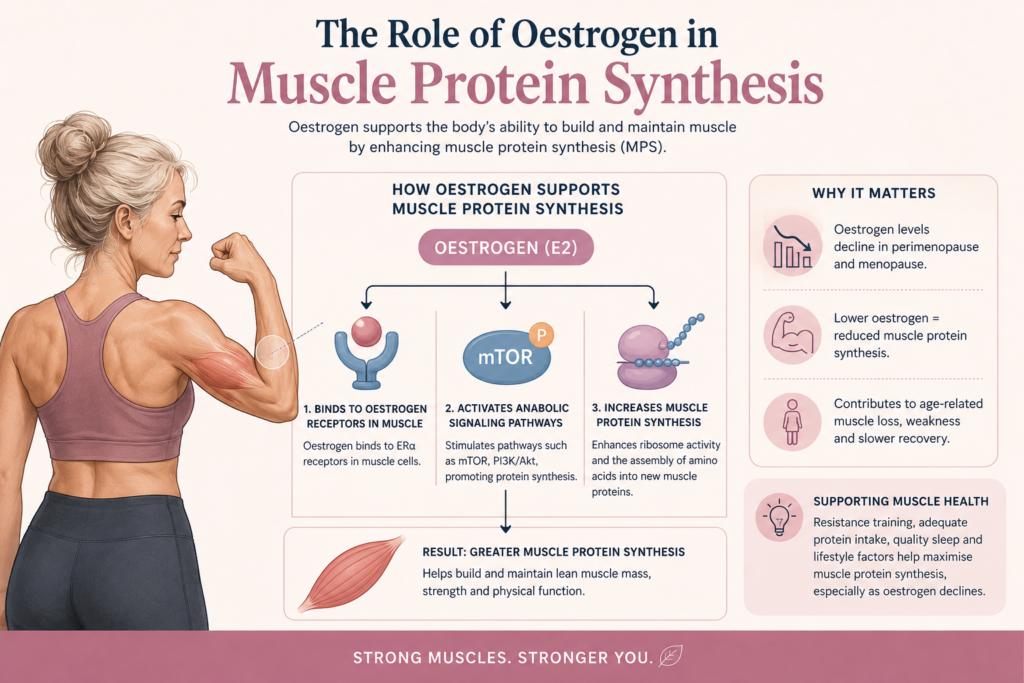
Oestrogen does far more than regulate your menstrual cycle. Research suggests it plays a role in muscle protein synthesis, helping muscle tissue respond to the protein you eat. As oestrogen levels begin to decline during perimenopause and into menopause, that efficiency appears to drop, and the protein intake that supported your muscle mass at 30 may not be enough at 45, even if nothing else about your diet has changed. The strongest research is in women after menopause, but we’re seeing the same pattern in women in perimenopause too. So rather than waiting until menopause is over, it makes sense to focus on getting enough protein during perimenopause as well.
Anabolic resistance: what it means for your muscles
Anabolic resistance is the term researchers use to describe muscle’s reduced ability to stimulate protein synthesis from a given protein dose. In practical terms, it means you may need a larger protein stimulus to trigger the same muscle-building response a younger woman would get from the same meal.
Again, the evidence for this effect is clearest in postmenopausal and older women, though findings are are often applied more broadly to women in perimenopause as well.
This isn’t about body image or weight loss; it’s about maintaining functional strength, stable energy, and bone support through midlife and beyond. Understanding this shift is empowering, not alarming, and it changes what good nutrition actually looks like at this stage of life.
Protein needs for women over 40: how much is enough?
Why the standard recommendation is probably too low
The official Recommended Dailly Allowance (RDA) of 0.8 g of protein per kilogram of body weight per day was set to prevent deficiency in the general adult population, not to support muscle maintenance in midlife. Current expert consensus, drawing on position statements and systematic reviews from sports nutrition and dietetics bodies, points to 1.0, 1.2 g/kg/day as a more protective target for women in their 40s and 50s. For women who are active or focused on preserving lean muscle mass, the evidence supports going higher, to around 1.2, 1.6 g/kg/day, particularly when combined with resistance exercise.
A simple guide by body weight
Rather than leaving you to do the maths, here’s what those ranges look like in real grams across common body weights. A 70 kg woman aiming for 1.2 g/kg/day needs roughly 84 g of protein each day. That’s achievable, but it does require some planning, particularly at breakfast, where most women fall well short.
| Body weight | 1.0 g/kg/day | 1.2 g/kg/day | 1.6 g/kg/day |
|---|---|---|---|
| 60 kg | 60 g | 72 g | 96 g |
| 70 kg | 70 g | 84 g | 112 g |
| 80 kg | 80 g | 96 g | 128 g |
The case for spreading protein across your day
Why timing and distribution matter for women in midlife
The evidence generally favours spreading protein across three to four meals rather than concentrating most of it at dinner, a pattern that alot of women fall into simply because of how busy mornings and lunches tend to be.
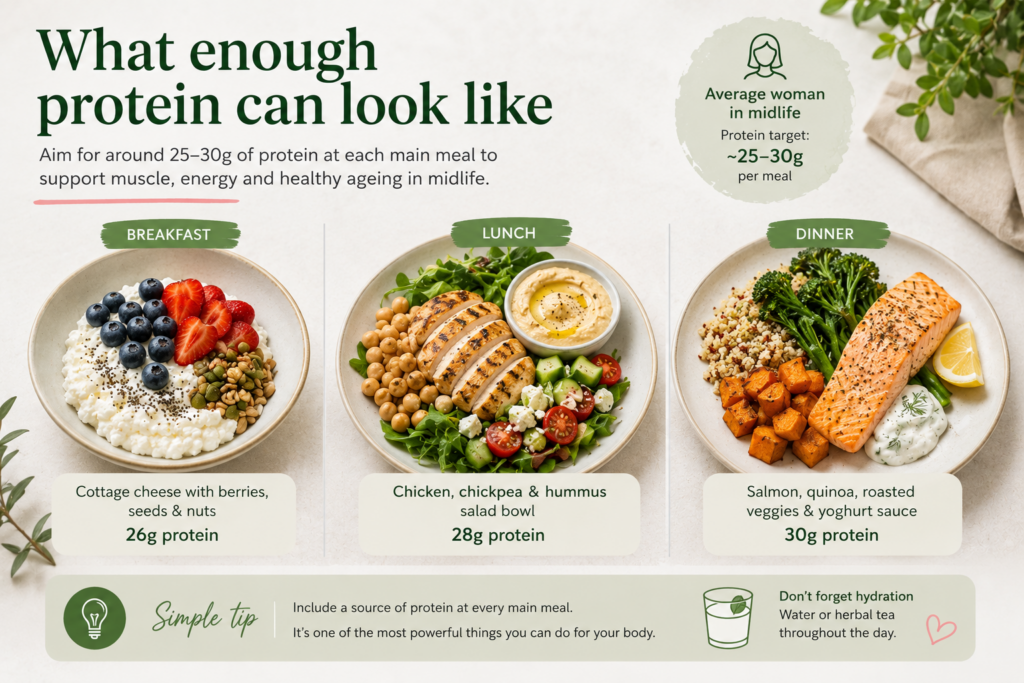
Aiming for around 25–30 g of protein at each meal is a practical way to support muscle health in midlife. While total daily protein intake remains the most important factor, there is some evidence to suggest that distributing protein more evenly across the day may offer additional benefit. In other words, it may be more helpful to include a meaningful serve of protein at breakfast and lunch, rather than relying on dinner to make up most of the day’s intake.
For this reason, eating 15 g of protein at breakfast, 20 g at lunch and 60 g at dinner may not support muscle maintenance in quite the same way as having roughly 30 g at each meal, even if the total daily amount is identical.
What this looks like in practice
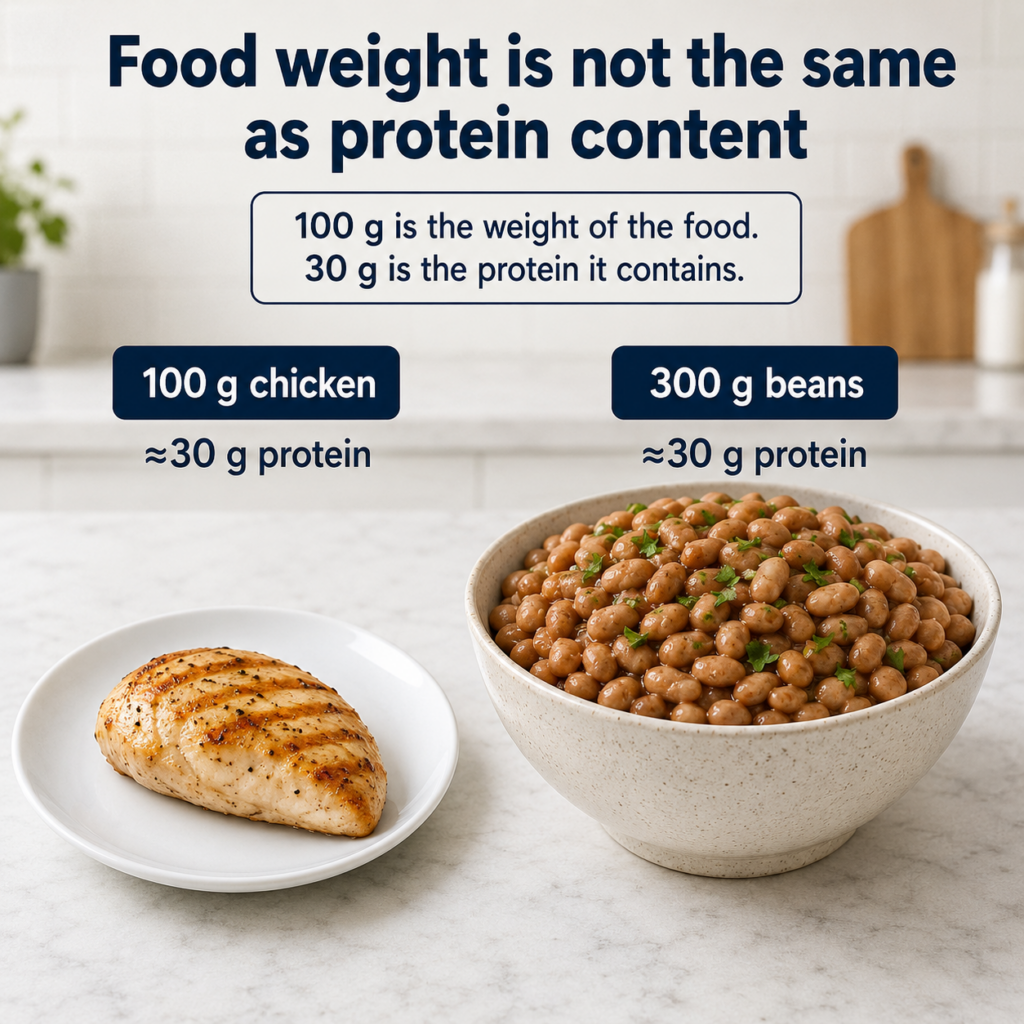
It’s important to distinguish between the weight of a food and the amount of protein it contains.
A target of 96 g of protein per day does not mean eating 96 g of meat, fish, tofu or beans. Rather, it refers to 96 g of the protein nutrient across the day.
For example, 100 g of chicken breast provides around 30 g of protein, while 100 g of cooked beans provides closer to 8–10 g. Reaching a daily protein target therefore usually requires a combination of protein-rich foods spread across meals and snacks.
Rather than a rigid schedule, think of it as a practical rhythm: a protein-forward breakfast, a lunch built around a substantial protein source, and a dinner that continues that pattern. An optional protein-rich snack can help if you find it difficult to hit your target across three meals alone.
The goal is reasonable consistency across the day, not perfection at every sitting. If breakfast has historically been toast or fruit on its own, that single meal is usually the biggest opportunity for improvement, and the shift doesn’t have to be complicated.
Building a protein-rich day: practical food ideas with gram counts
Breakfast options that actually hit the target
Breakfast is where most women fall short on their daily protein intake, and it’s usually the easiest place to make a meaningful gain.
🌿A three-egg omelette with 30 g of cheese delivers around 28 g of protein.
🌿A Greek yoghurt bowl with a handful of nuts and a half scoop of whey protein comes in at approximately 30 g.
🌿Protein oats made with rolled oats, a cup of full-cream milk, and linseed provide around 20 – 22 g, a solid foundation even if it sits slightly below the 25 – 30 g ideal. Throw in a tbsp of chia seeds and get an extra couple of grams.
🌿Adding yoghurt or cottage cheese can help you increase the protein simply.
Any of these options keeps you in the right range with minimal preparation time.
Lunch and dinner ideas that work in a busy life
Several practical options can comfortably deliver 30 g or more at a single sitting.
🌿A tuna and lentil salad combining a 95 g tin of tuna with a cup of cooked lentils delivers around 37 g of protein.
🌿A chicken and salad wrap with 120 – 130 g of cooked chicken sits at approximately 30 g.
🌿Salmon with potatoes and greens from a 150 g serve reaches around 32 g,
🌿Lean mince chilli with kidney beans lands at 35 – 40 g depending on the serve.
A 100 – 130 g serve of chicken, fish, or lean meat is usually enough to reach 25 – 35 g at dinner without needing a huge plateful. This often surprises women who assumed they would need far larger serves than feel comfortable.
Snacks that contribute meaningfully
Snacks can contribute 10 – 18 g of protein on their own, so pairing matters if you want them to pull their weight.
🌿Greek yoghurt with a handful of nuts,
🌿Tinned tuna with wholegrain crackers, or
🌿Two boiled eggs with a cheese stick are all easy, packable options that sit closer to 18 – 20 g.
On protein powder: it’s a convenient supplement, not a requirement. I generally prefer to focus on whole-food sources of protein first, as they provide not just protein, but other important nutrients as well.
Protein powders can still be a useful convenience option, especially when time is short, but they are a supplement rather than a necessity. Most women can meet their protein needs without them with a little planning and a varied diet across the food sources above will get most women to their goal consistently. You can check out more information here: Protein Powder in Menopause: What Actually Supports Muscle.
A few safety considerations worth knowing
When higher protein is generally safe
For healthy women without pre-existing kidney conditions, increasing protein intake to 1.2, 1.6 g/kg/day is considered safe and well-tolerated. The current body of evidence, including systematic reviews in healthy adults, finds little to no adverse effect on kidney function markers at these levels. The concern that a moderate protein increase will damage healthy kidneys is not well supported by the research, and current consensus among dietitians and sports nutrition bodies supports these intakes as appropriate for most healthy adults.
When to check with your GP first
There are specific situations where protein targets need to be individualised before you increase your intake. These include pre-existing kidney disease or reduced kidney function, type 2 diabetes with kidney complications, and use of GLP-1 medications where appetite suppression already affects overall food intake.
Very high intakes of red and processed meat can also raise cardiovascular and kidney-stone risk, so variety across protein sources is always a smarter long-term strategy than relying heavily on a single food. If any of these apply to you, a conversation with your GP before making significant changes is a sensible first step.
Getting more protein without it feeling like another food rule
Why most protein advice misses the mark for women in midlife
Many women in their 40s have already spent years following rigid nutrition plans that didn’t last. Being handed a strict gram target and a printed meal plan can trigger the same exhausting cycle all over again. What actually works is understanding why protein matters at this stage of life, then finding ways to increase it that fit your existing lifestyle rather than replace it entirely. Small, consistent shifts at breakfast and lunch tend to move the needle more than a complete overhaul of how you eat.
How Sally works with women at Gutsy Solution
At Gutsy Solution, I take a non-diet, personalised approach to increasing protein intake for women in their 40s and beyond. Rather than handing over a fixed meal plan, I work with each woman’s current food patterns, preferences, and daily life to identify small, sustainable shifts, the kind that stick because they feel manageable, not because they’re enforced.

My Gutsy Clarity consultation produces a written plan built around your actual life, with a follow-up session to address what’s working and what isn’t.
Available via telehealth to women across Australia, the process starts with a free 20-minute discovery chat for anyone wondering whether this kind of support is the right fit for them.
Where to go from here
Adequate protein for women over 40 isn’t about eating chicken at every meal or tracking grams with military precision. It’s about understanding that your body’s needs have genuinely shifted, knowing approximately how much protein to aim for each day, and building meals that support your muscle, energy, and satiety in a way that feels realistic and sustainable.
The targets in this article are achievable through everyday food, without dramatic dietary change or expensive supplements.
A protein-rich breakfast and a balanced lunch are usually where the biggest gains are made, and those shifts are smaller than most women expect.
If you’re not sure where to start, or you’d like support that is genuinely personalised and non-restrictive, a free discovery chat with me is a practical next step.
You don’t have to figure this out on your own.